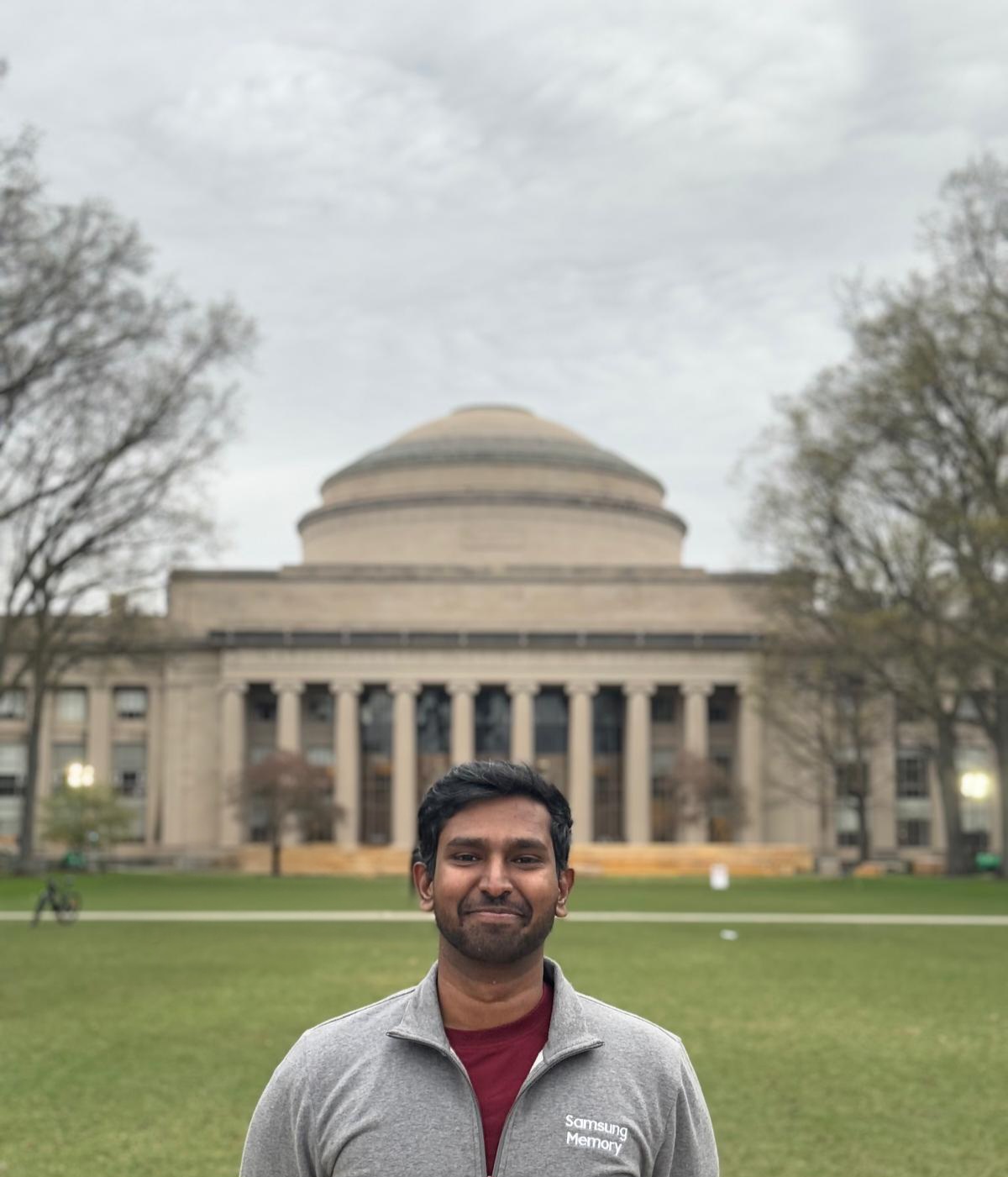
About Me
TL;DR: I’m pretty good at context-agnostic Signal Processing, Machine/Deep Learning and High Performance Computing.
I’m a Senior Engineer at KLA Ann Arbor, where I build tools for process control and yield management for the semiconductor industry.
Professionally, I’ve had the privilege of working in state-of-the-art environments in multiple industries. During my time in defense R&D, I built signal processing pipelines for SONAR technologies ranging from uniform-linear-array systems to SOTA synthetic-aperture imaging systems. I also had the opportunity to intern at Intuitive Surgical in the AI&I division, where I built imaging stages and enabled integration of R&D pipeline with CUDA-backend. And prior to joining KLA, I was a Visiting Researcher in Computational Imaging Systems Laboratory at Boston University, where I built fast NeRF-based methods for ptychographic pipelines and accelerated pipelines for multi-camera array microscope.
During graduate school, my areas of focus were various topics in Applied Signal Processing and Deep Learning.
My endeavors have allowed me to gain valuable experience and proficiency in Applied Signal Processing & Deep Learning: Computer Vision, Computational Imaging, Autonomous Driving, Audio, SONAR, and High-Performance-Computing Programming. I firmly believe that creative and successful R&D stems from a deep understanding of a core domain, complemented by a working knowledge of related domains. Thus my project selection approach is rooted in fundamental principles rather than being constrained by specific domains. That being said, I have a soft spot for projects that involve going from theorizing, all the way to low-latency builds.
Research Interests
Due to my interest in applied signal processing, most of my projects lies in Signal & Image Processing, Computer Vision, Robotic Perception, Machine & Deep Learning. Currently, I’m learning how to build low-latency C++ pipelines for these topics. While building an effective pipeline is a great achievement, building a faster pipeline is even better. Professionally, I’m investigating low-latency deep neural methods to improve computational imaging methods without performance trade-offs.
Key Expertise:
- Domains: Signal Processing: Audio, Speech and Image, Computational Imaging, Machine Learning, Machine Vision, Supervised, Unsupervised, and Reinforcement Learning.
- Tools: Matlab, Matlab Executable CUDA(MexCuda), Numpy, SciPy, PyTorch, CUDA, CuBLAS, Nvidia Performance Primitives (NPP), LibTorch (C++ backend/API to PyTorch).
- Programming Languages: C, C++, CUDA, Python, Matlab, and Bash
Education
- Master of Science: Electrical and Computer Engineering, Boston University
- Bachelor of Technology, Electronics and Communication Engineering, College of Engineering Trivandrum
Employment
- Senior Algorithm Engineer, KLA
- Visiting Researcher, Computational Imaging Systems Lab
- MS Project Intern, Yobe Inc
- Advanced Imaging SW Engr Intern, Advanced Imaging and Intelligence, Intuitive Surgical
- Electronics Engineer, Naval Physical and Oceanographic Laboratory, Defence Research and Development Organisation
- Project Intern, Naval Physical and Oceanographic Laboratory, Defence Research and Development Organisation
- Undergraduate Intern, Naval Physical and Oceanographic Laboratory, Defence Research and Development Organisation
- Undergraduate Assistant, Department of Electronics and Communication Engineering, College of Engineering Trivandrum
Projects
MS Research Project, Electrical and Computer Engineering, BU
- Designed and trained a Wave-U-Net variant to reduce black-box ASR transcription errors (word-error-rate).
- Designed a custom loss function leveraging ASR system properties, STFT features, and auditory perception.
- Achieved WER reductions on OpenAI Whisper: 6.7% at SNR = 3, 4.2% at SNR = 6 and 1.37% at SNR = 9.
- Code, Poster and Paper available at: Speech Enhancement for Robust Automatic Speech Recognition
Audio Denoising, Boston University, College of Engineering
- Developed an audio denoising pipeline containing a classical audio processing stage and a neural-net based stage.
- The audio processing stage is based on smoothed spectral-subtraction and neural-net stage is a 4 layered FCN.
- Introduced novel method of combining heterodyning and denoising to overcome long-tail problem in neural nets.
- Code and Report available at: Audio Denoising: A Heterodyned Approach
Sim2Real AV-Agent Deployment, Boston University, College of Engineering
- SIM2REAL is a robotics concept involving training an agent in simulation before deploying in real environments.
- The project involved pioneering a new domain randomization approach to enable robust SIM2REAL for vehicles.
- Configured a robotic agent in CARLA and an RC car to collect expert driving data through manual operation, implemented diverse perception-to-control pipelines, and trained the vehicle pipelines using imitation learning.
- The proposed method produced significant improvements in agent performance: obtained an average decrease of 17% in Steer-MAE, 11.5% in Steer-SW-MAE, 11.5% in Action-MAE.
- Succesfully created an agent agnostic to appearance differences, enabling successful and similar performance in both simulation and reality. Code and Paper: A Style Transfer Approach To Appearance Agnostic Agents
End-to-End Vehicle Autonomy, Boston University, College of Engineering
- Implemented policy-function using reinforcement learning, imitation learning, and behavior cloning approaches.
- The policy function stage comprises of a CNN and a FCN for mapping images to car control commands.
Underwater Signal Simulator, Naval Physical and Oceanographic Laboratory
- Authored fast signal simulator for underwater sensor arrays: uniform linear arrays (ULAs) and uniform planar array (UPAs).
- Engineered MATLAB-based vectorized signal simulator for diverse ocean environments and sensor arrays.
- Involved designing efficient ray-tracing and simulating doppler shifting and other signal propagation characteristics.
- Developed to assist and assess sonar imaging algorithms. Achieved 7x speed by further translating to CUDA C.
Computational Sonar Imaging, Naval Physical and Oceanographic Laboratory
- Realised 4 beamforming-based computational imaging algorithms each for front-looking SONAR and side-scan SONAR.
- Wrote MATLAB pipelines employing full-aperture, dynamic-aperture, constant range-cell, and variable range-cell methods.
- Wrote vectorized MATLAB code for a low latency implementation.
- Setup test-benches with physics-based signal simulation pipelines and imaging pipelines to mimic real-time performance.
DSP Firmware, Naval Physical and Oceanographic Laboratory
- Created DSP firmware with multiple modes and functionalities meeting client specifications and project constraints.
- Modes involved match-filtering for signal detection, and signal processing based on the current mode of operation.
- Programmed, tested, and integrated functionalities in MATLAB; later translated to C (primarily C89).
- Unified, tested, and assessed DSP firmware for deployment on TIVA-C, an ARM Cortex-M4F based MCU.
Attendance Registration Using Face Recognition, College of Engineering Trivandrum
- Built an attendance registration system using a deep learning pipeline to deploy in a classroom setting.
- The machine learning stage consists of a CNN-based feature-extractor and a FCN based feature-classifier.
- The final attendance registration pipeline produced precision $ = 98.4%, recall = 98.4% and an F-1 score of 0.984.
- Submitted, presented and showcased system to project committee, faculty, and students as part of curriculum.j
Image Steganography, College of Engineering Trivandrum
- Studied over 200 publications and reproduced 30+ image steganography methods in MATLAB and Python.
- Publications consists of classical steganography methods and data-driven steganography methods.
- Conducted to generate metrics for baseline comparisons added to graduate student’s thesis and publications.
- Performed as part of undergraduate assistant duty to assist professor’s graduate students (assisted two students).
Miscellaneous
Matlab x CUDA
I’m writing a book! It introduces engineers to integrating MATLAB with CUDA backends to develop low-latency pipelines, an approach commonly used in various R&D environments. Its under construction but if you’re impatient and don’t mind half-cooked content, you can check it out here: An Introduction to Matlab x CUDA
Online Learning
The following courses allowed me to gain a deep and rigorous understanding of machine learning and the data-driven paradigm. Thanks to College of Engineering Trivandrum for sponsoring and allowing me to learn free of cost.
- Machine Learning, Stanford University
- Data Science: Foundations using R Specialization, Johns Hopkins University
- The Data Scientist’s Toolbox, Johns Hopkins University
- Deep Learning Specialization, Deeplearning. AI
- R Programming, Johns Hopkins University
- Getting and Cleaning Data, Johns Hopkins University
- Exploratory Data Analysis, Johns Hopkins University
- Reproducible Research, Johns Hopkins University
- Statistical Inference, Johns Hopkins University
- Regression Models, Johns Hopkins University
- Practical Machine Learning, Johns Hopkins University
- Developing Data Products, Johns Hopkins University
- Neural Networks and Deep Learning, Deeplearning. AI
- Improving Deep Neural Networks: Hyperparameter tuning, Regularisation and Optimization, Deeplearning. AI
- Structuring Machine Learning Projects, Deeplearning. AI
- Convolutional Neural Networks, Deeplearning. AI
- Sequence Models, Deeplearning. AI
Autonomous Underwater Vehicles: A Perception & Control Approach
This side-project is an attempt to bring together my skills in beamforming-based computational imaging, signal simulation, perception \& control and reinforcement learning to enable the simulation and demonstration of an AUV designed for seafloor surveillance.
The objectives involve the creation of signal simulation pipelines to mimic the signals received by the uniform-linear-arrays of the AUV in a real underwater environment, imaging pipeline to produce acoustic images from the simulated signals using beamforming techniques, and a control pipeline that takes the acoustic images and produce state-to-action mappings to control the AUV.
The project is written in C++ (with STL as primary library) and is currently under development, but you can explore its progress at AUV Repository.
Self Learning
- Goodfellow, I., Bengio, Y., & Courville, A. (2016). Deep Learning. MIT Press.
- Sutton, R. S., & Barto, A. G. (2018). Reinforcement Learning: An Introduction. MIT Press.
- Kirk, D. B., & Hwu, W.-m. W. (2016). Programming massively parallel processors: A hands-on approach (3rd ed.). Morgan Kaufmann.
- Guntheroth, Kurt. Optimized C++: Proven Techniques for Heightened Performance. O’Reilly Media, 2015.
- Hennessy, John L., and David A. Patterson. Computer Architecture: A Quantitative Approach. 6th ed., Morgan Kaufmann, 2017.
- Sehr, V., & Andrist, B. (2018). C++ High Performance. Packt Publishing.
- Bancila, M. (2017). Modern C++ Programming Cookbook. Packt Publishing.
Contact
- primary email: vrs [at] bu [dot] edu (I highly suggest using this)
- personal mail: vrsreeganesh [at] gmail [dot] com
- alternative: vrsreeganesh [at] cet [dot] ac [dot] in